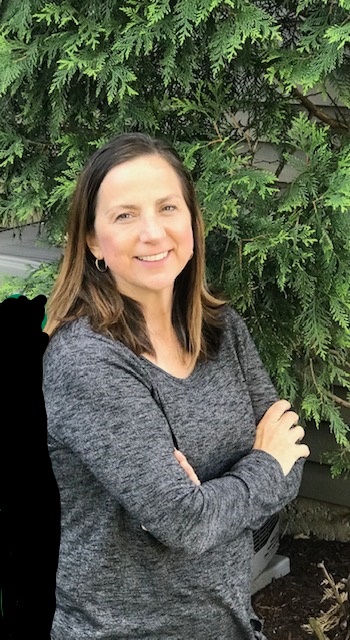
Nurse: Michelle Bouchard, MPH, BSN, RNC-NIC, Clinician IV
Title/Position: Site sustainability Lead, Advocate Christ Medical Center & Children’s Hospital
Michelle Bouchard worked as a NICU nurse for 39 years and her work has always been and remains grounded in the American Nurses Association Code of Ethics.
In 2007, as she was feeding a baby in the NICU, she was recalling the word “environment” in her nursing’s professional practice model at that time. She thought about the di-(2-ethylhexyl) phthalate, otherwise known as “DEHP” in the neonatal volu-feeder bottles and the intravenous tubing to which the infants were being exposed and how the infants receive hyperalimentation through this tubing, sometimes for several weeks. “We used unsafe cleansers in the unit at the time to clean our isolettes and flooring… and I thought, ‘How does this impact our neonates with fragile lungs, and our pediatric population with asthma?” Bouchard took a picture of the professional practice model which aligned human health and environmental health and brought it to her manager and asked if they could do more to align with their nursing practice model. To this day, Michelle is grateful to her NICU manager’s support in launching her journey.
Initiative Overview
Since that moment in 2007, over the course of many years, Bouchard continued to stress and define the connection between environmental health and human health to those in her facility, receiving growing support from the fellow mentors. colleagues and her leadership. Working with her nursing leadership, she began dedicating one day per week to healthcare sustainability, then two, and in the last two years, she does sustainability work full time and is no longer at the bedside. As the site sustainability lead over three campuses for Advocate Christ Medical Center & Children’s Hospital she developed and oversees a 160 team-member, Green Advocate’s Team (which includes both clinical and non-clinical staff) and provides support for the staff of these campuses, finding ways to reduce waste and making the environmental health connection whenever and wherever she can. Bouchard supports and provides education to all team members through rounding the floors and educating colleagues, as well as delivering ongoing education externally whenever she finds an opportunity.
Project Implementation
While nearly 80% of Bouchard’s Green Advocate’s team are clinicians, she works hard to include all non-clinical staff in her work as well: “We need all hands-on deck, this is not the sole responsibility of the EVS team.” Part of her role is to engage and empower nurses’ involvement in healthcare sustainability, and she does this by incorporating recognition and opportunities for nurses to advance in the clinical ladder when they engage in sustainability work. “Clinicians are now rolling out their own sustainable initiatives within their units and applying these programs towards our Advance Magnet clinical ladder process. Incorporating sustainability initiatives into prioritized safe patient care can be quite a challenge.” Bouchard works daily to strategize with all staff, including nurses, and when nurses want to spearhead a project, she provides them with signage, newsletter content, educational PowerPoints, and overall support.
The facility has a strong, streamlined “Clean Stream Recycling” program of aluminum, plastic, and glass. The different projects and campaigns she has overseen in her role, include “Medical Device Reprocessing is SMART,” unused medical supply donations, “Bedside Hoarding Reduction” – measuring and auditing the waste left at the bedside after patient discharges, as well as “AMP UP the Battery Recycling.” Bouchard notes that “Some projects like “Bulking UP the Cardboard Recycling” are “low hanging fruit” and are a wonderful way to engage staff new to sustainability efforts.” She described how she incorporated research on the health benefits of patient and staff “Quiet Hours” into her project, while measuring the associated energy conservation and cost savings. The goal extended beyond identifying financial savings. It sought to demonstrate how nursing can advance environmental health through everyday practices. By reducing lighting during designated quiet hours, the project highlighted how simple energy conservation measures can support patient healing, staff well-being while also reducing energy consumption and lowering operational costs.
Bouchard states the OR is one of the largest producers of waste. Surgical blue wrap is a nuisance in healthcare, because it is non-biodegradable and hospitals accumulate so much, but it is necessary for keeping sterile kits safe. The OR collects unused supplies from surgical cases that would otherwise be disposed of, as well as the used blue wrap and donates these items to the local animal welfare. “In 2025, our OR was able to capture over 75 tons of surgical blue wrap and unused medical supplies to the Animal Welfare, the blue wrap is used to line the animal cages and provide cleanliness and warmth and every bowl, surgical dressings etc. are donated to our community partnerships.”
A few transportation projects led by the Green Advocate’s Team is the “Bike to Work Perk” program in which volunteers tag bikes and distribute free meal passes for those who participate in the “Bike to Work” program. Another project implemented several years ago was the “Prime Parking for Carpoolers” program. Bouchard also gives out free meal passes when she sees people engaging in personal sustainability efforts such as using a reusable cup or tasks related to environmental stewardship.
One of the ways Bouchard credits her success is that she incorporates the Magnet process into her work. Just this past year, Bouchard presented a podium presentation at the ANCC Magnet conference on nurses leading healthcare sustainability. She has also collaborated with other leaders in the field of sustainability including Joan Widmer of the New Hampshire Nurses Association creating a policy proposal on Nurses Leading Healthcare Sustainability. Bouchard notes that of the 23 states they reached out to for sign-on and endorsement, 17 signed on, with the proposal successfully passing.
Collaborators
Bouchard credits much of her site’s successes to the hospital leadership for supporting her work, as well as their 160-member Green Advocates Team. Her team’s enthusiasm and passion to do better in providing safe, as well as environmentally responsible, patient care is what keeps her going. Also, incorporating the Magnet process into sustainable initiatives over the years has made the most impact for the success of reducing their environmental footprint. Incorporating sustainability with the Magnet process has also helped to expand engagement, environmental stewardship and culture.
Bouchard’s work is not always easy, and it is sometimes a struggle but “I keep pecking away to make an impact, always making adjustments to programs, increasing the data metrics on our dashboard… it’s been an evolution.” Recounting the nearly 20-year sustainability journey she has undertaken at the facility, she notes the ongoing passion to make the connection between environmental health and human health.
Results and Impact
The facility has received Practice Greenhealth’s Environmental Excellence Award since 2023 being listed in the “Top 25” of the 2026 Top 25 Environmental Excellence Award Honorees with Practice Greenhealth. Bouchard works closely with different departments, “Talking Trash” with facility vendors, collaborating with those in facilities management, purchasing, and environmental services. There are days she is out on the waste dock auditing, or “dumpster diving” as she says, taking photos of improper waste segregation and looking for areas of improvement in workflow processes. While Bouchard is no longer at the bedside, her years of expertise and sustainability work allow her to give the “boots on the ground” perspective as someone familiar with the hospital’s processes.
Advice for Nurses Starting Similar Initiatives:
For nurses just embarking on this type of work Bouchard notes that they should utilize the ANA: Code of Ethics as leverage; particularly Provision 10.3. This has been Bouchard’s “Holy Grail.” Also, “start out projects within your own nursing unit, build a unit green team.” She also underscores the need to establish support from nursing leadership. The CNE’s, from the sites she covers, are Bouchard’s executive sponsors for leading healthcare sustainability. Bouchard meets with her leadership 1:1 monthly as well as reports out to the entire nursing leadership quarterly in leadership meetings. Ongoing communication not only helps to provide updates on current initiatives but also embeds a stronger sustainable culture. Bouchard says that she hopes to inspire other nurses. “Start small and peck away, celebrate each win and give recognition and kudos to those who support environmental stewardship…they are going above and beyond” to care for the environment while focusing on safe patient care.
American Nurses Association. (2015). Code of ethics for nurses with interpretive statements. https://codeofethics.ana.org/home
Melnyk, A., & Artsen, A. (2025, February 10). Reducing health care waste through device reprocessing. Federation of American Scientists. https://fas.org/publication/device-reprocessing-health-care/
Practice Greenhealth. (June 3, 2026). Practice Greenhealth announces 2026 Environmental Excellence Award recipients. https://practicegreenhealth.org/about/news/practice-greenhealth-announces-2026-environmental-excellence-award-recipients
Riopell, M. (July 20, 2020). Health care heroes: Reducing waste and helping animals at the same time. Advocate Health Care, Aurora Health Care: Health enews. https://www.ahchealthenews.com/2020/07/20/health-care-heroes-reducing-waste-and-helping-animals-at-the-same-time/